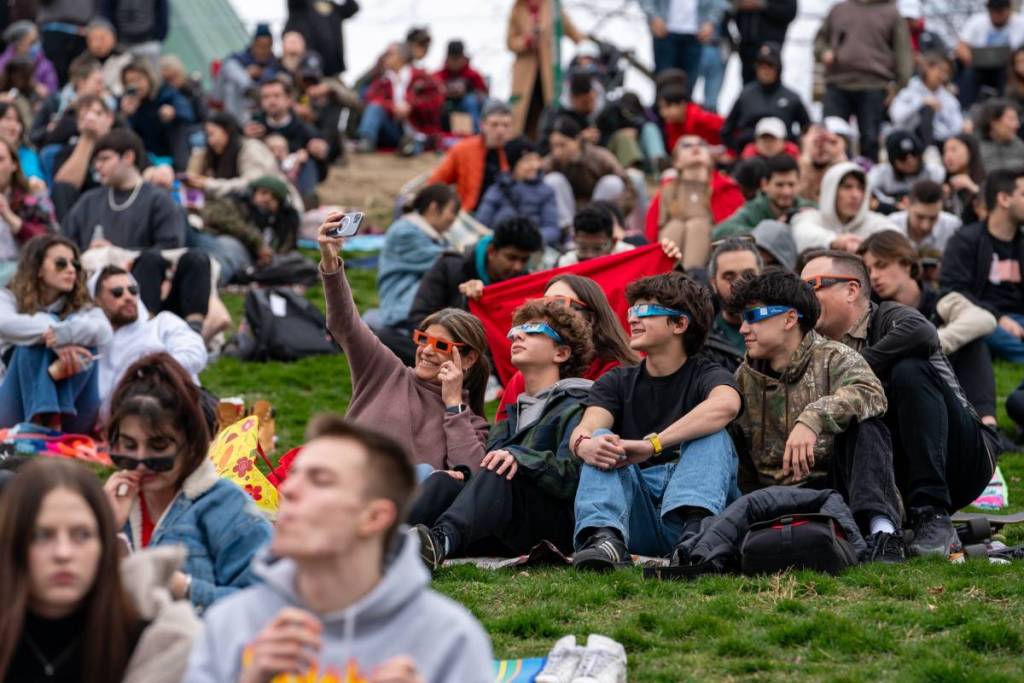

You can still enjoy tonight’s solar eclipse even if you missed out on those elusive eclipse glasses – you just need to get a bit crafty and stick to indirect viewing.
First, a quick safety warning
Never look directly at the Sun, even during a partial eclipse or “for just a second”. It can permanently damage the retina and you won’t feel it happening.
Ordinary sunglasses, 3D glasses or fashion shades do not offer enough protection – they cut glare but not the intense solar radiation.
Only certified eclipse glasses or handheld solar viewers that meet international safety standards are safe for direct viewing, and damaged or scratched lenses shouldn’t be used.
With glasses sold out across much of the UK, here are five safe, expert-approved ways to watch the eclipse indirectly.
1. Make a simple pinhole viewer
If you’ve got two bits of card and a pen, you’ve got a DIY eclipse viewer.
- Take a sheet of card and poke a small, clean hole in the middle using a pen, pin or pencil – the smaller the hole, the sharper the image.
- Stand with your back to the Sun and hold the card up so sunlight passes through the hole.
- Hold a second sheet of white paper or card behind it, on the ground or against a wall, and watch the image of the Sun appear as a bright circle or crescent as the Moon “takes a bite” out of it.
Because you’re looking at the projected image on the paper and not at the Sun itself, this method is safe and ideal for kids and anyone without specialist kit.
2. Try the colander trick
The humble kitchen colander doubles up as a multi‑image eclipse projector.
- Stand with your back to the Sun and hold the colander so sunlight shines through the holes.
- Let the light fall onto a plain surface – a white wall, paving slab, or a sheet of paper works well.
- Each hole acts like a tiny pinhole, creating lots of miniature Suns that turn into crescents as the eclipse deepens, you’ll get dozens or even hundreds of tiny eclipse images at once.
Consultant ophthalmologist David Jones has called this his favourite method because you can “make 100 pictures of the Sun all at once” using nothing more than a kitchen staple.
3. Build a dark box viewer
A box pinhole projector gives you a sharper, high‑contrast view of the eclipse, and you can make one in about 10 minutes.
- You’ll need: a cardboard box (cereal box is perfect), white paper, aluminium foil, scissors, tape or glue, and a pin.
- Line one inside end of the box with white paper, this is your “screen” where the Sun’s image will appear.
- On the opposite end, cut or poke two small holes: one will be your viewing window, the other will be the pinhole.
- Cover the pinhole with a flat piece of aluminium foil and tape it securely, then poke a tiny hole in the foil with a pin or needle.
- Seal the box, stand with your back to the Sun, point the foil‑covered end towards the light and look through the viewing hole – you should see a crisp, inverted image of the eclipsed Sun on the white paper inside.
Because the interior of the box is dark, the projected image stands out clearly, giving what Jones describes as a “really good picture of the eclipse” without any risk to your eyes.
4. Let the trees do the work
If you’re in a park or somewhere leafy, nature can turn the whole ground into an eclipse gallery.
During a partial eclipse, sunlight filtering through gaps between leaves acts just like hundreds of tiny pinholes.
Stand under a tree and look at the patches of light on the pavement, walls or nearby surfaces – each bright spot will show the Sun’s shape, turning from round disks into crescent‑shaped projections as the Moon moves across.
This indirect method is completely safe because you’re only looking at reflected or projected light, not at the Sun itself.
5. Watch a professional livestream
If the clouds roll in, or you’d rather stay indoors, a livestream is the safest and arguably the comfiest way to experience the eclipse.
The Royal Observatory Greenwich and the Astronomical Society of Edinburgh are streaming the eclipse live, using properly filtered solar telescopes and cameras.
This option is ideal if you’re worried about eye safety or you’re supervising young children, you get expert commentary and close‑up views with none of the risk.
Join an astronomical society event
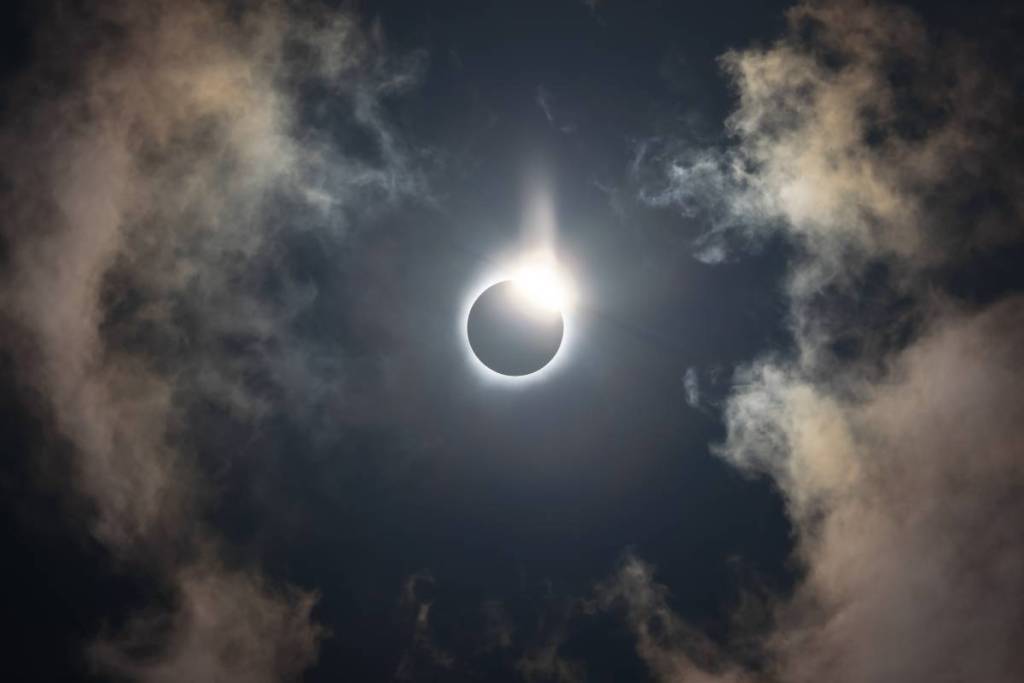
If you’d prefer a more social experience, many UK astronomical societies are running eclipse‑watching events with proper kit on hand.
Groups such as the South London Astronomical Society, Reading Astronomical Society and the Astronomical Society of Edinburgh are hosting public viewings with certified eclipse glasses and solar‑filtered telescopes.
Organised events generally follow strict safety guidance from organisations like the UK Health Security Agency (UKHSA), making them a good option if you’re unsure about DIY methods.
You’ll also get the bonus of expert explanations and a bit of community atmospher, ideal for turning a rare celestial event into a memorable evening.
What happens if you look at the eclipse without protection?
Eye specialists and the UKHSA are clear: staring at the Sun, even when it looks dimmer during an eclipse, can cause serious and sometimes permanent damage.
The dimming effect can trick your brain into thinking it’s safe to look, overriding your usual instinct to glance away.
Intense light focuses on the retina, and because the retina has no pain receptors, you won’t feel any burning or damage as it happens.
After the 1999 total solar eclipse, the Royal College of Ophthalmologists recorded around 70 cases of vision problems linked to watching the event, with around 40% of those people having looked for under a minute.
If you experience blurred central vision, blind spots or distorted shapes after glancing at the Sun, seek urgent medical advice.
Whatever you do this evening, resist the urge to “just have a quick look” your eyes won’t thank you in 2090 when the UK finally gets its next total solar eclipse.