
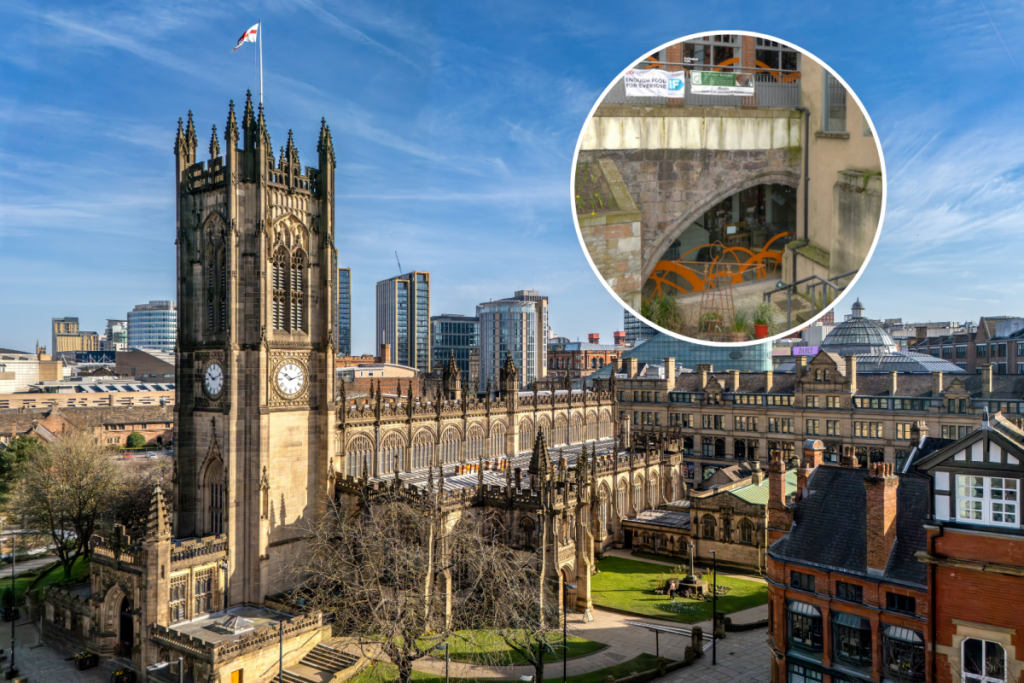

We’ve always had a bit of a morbid fascination with the macabre, and frankly, the spookier something sounds, the better. One spot in Manchester that isn’t all it seems, though, is the area of Hanging Ditch, around the Corn Exchange leading to Corporation Street, and its accompanying Hanging Bridge – and although they actually have nothing to do with hanging in the old fashioned death penalty sense, there is a no less interesting story behind these medieval structures.
Hidden beneath modern street level adjacent to Manchester Cathedral sits Hanging Bridge, a remarkably intact two-span stone bridge built in 1421 that spent centuries completely sealed inside the basements and foundations of Victorian commercial buildings.
Recommended Articles
 Manchester’s spectacular free Christmas Parade returns next month with over 400 performers & a huge Candyland Castle float – new St Peter’s Square route, road closures and where to watch
 In 2026, Manchester’s 159-year-old Mr Thomas’s Chop House quietly completed a £300,000 restoration; the Cross Street institution will now open on Christmas Day for the first time in its history, under a 23-year-old head chef
The 2002 excavation: Unearthing the ditch
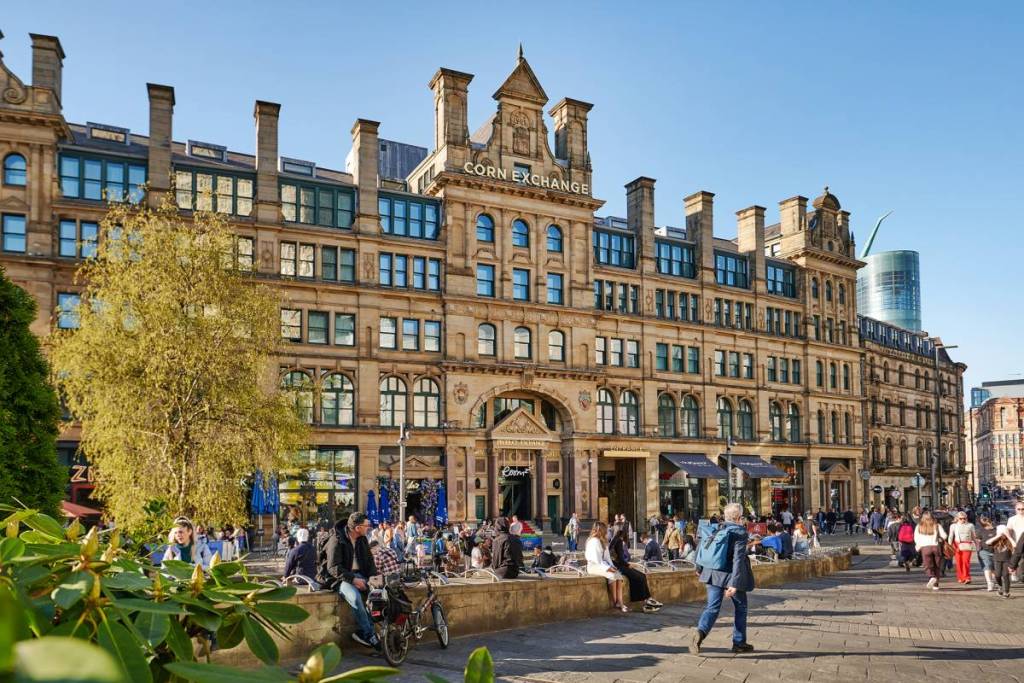
Before Manchester’s rapid industrial expansion paved over its medieval topography, the Hanging Ditch was an open, defensive ravine linking the Rivers Irk and Irwell. The 1421 sandstone bridge—likely replacing an earlier 14th-century timber crossing mentioned in 1343 records as Hengand Brigge—served as the primary southern access route connecting the medieval township to the collegiate church (now Manchester Cathedral).
The reason for the ‘hanging’ name, of both the ditch and bridge, is said to purely refer to the way the land hung over the ravine below, as the difference in levels was supposedly pretty stark. Nothing to do with medieval torture, but hard to imagine all the same.

By the late 17th and 18th centuries, the ditch had become an unsanitary open drain, so it was eventually culverted, infilled, and built over with townhouses and warehouses. Although Victorian workers briefly exposed the bridge during construction work in 1880 and held a short-lived public exhibition in 1892, it was re-entombed inside the cellars of Hanging Bridge Chambers and forgotten by the general public.
Between 1997 and 2001, archaeologists from the University of Manchester carried out full-scale excavations ahead of a £2.9 million project to construct the Manchester Cathedral Visitor Centre. The dig cleared decades of rubble and Victorian brick infill, revealing two intact, four-centred pointed arches constructed from local, honey-red Collyhurst sandstone.
In 2002, the site officially reopened to the public when Queen Elizabeth II unveiled the new visitor centre, permanently integrating the Scheduled Ancient Monument into the building’s subterranean footprint.
How to visit the arches today

The bridge remains preserved in situ beneath street level inside the Manchester Cathedral Visitor Centre complex, incorporated into the basement level that originally housed St Denys’ Bookshop and exhibition facilities.
- Location: 10 Cateaton Street, Manchester, M3 1SQ (directly opposite the south side of Manchester Cathedral and adjacent to Exchange Square).
- Entering the space: Enter via the main doors of the Visitor Centre on Cateaton Street. Rather than stopping at ground-floor displays, take the stairs or lift down to the lower ground/basement gallery.
- The street-level exterior angle: If the interior centre has reduced access due to cathedral events, walk outside along Cateaton Street toward the sunken courtyard. You can look downward through the sunken lightwell to see the exterior curve of the eastern arch exposed to open air.
Learn more about medieval Manchester

Manchester hosts its Medieval Faire annually in September, where you can celebrate and learn about Manchester’s medieval history. Browse stalls, learn medieval crafts and experience what life was like when Hanging Bridge was built.
Outside of the annual festival, you can visit Manchester’s Medieval Quarter all year round, taking in Manchester Cathedral, The Shambles, The Old Wellington pub and of course, Hanging Ditch. There are plenty of reminders of Manchester’s past, and the likes of Chetham’s Library and nearby John Ryland’s Library have specialists to talk you through the complexities of the past.
