
In 1797, on a stretch of countryside just northeast of Manchester’s city centre, Scottish millwright brothers Adam and George Murray began laying the groundwork for an architecture that would rewire the global economy. Migrating from Dumfriesshire as machinery designers, the Murrays saw an opportunity in fine cotton spinning that required unprecedented scale.
By raising the eight-storey Old Mill out of roughly 400,000 hand-moulded red bricks, they erected the world’s oldest surviving urban steam-powered cotton factory—and in doing so, transformed the rural district of Ancoats into the world’s first industrial suburb.
Before Murrays’ Mills, textile manufacturing relied heavily on rural river valleys for water power. The Murray brothers disrupted this tradition by placing their enterprise directly within the city, powered by a pioneering 12-horsepower Boulton & Watt steam engine. The sheer height of the eight-storey complex sent shockwaves through Victorian engineering.
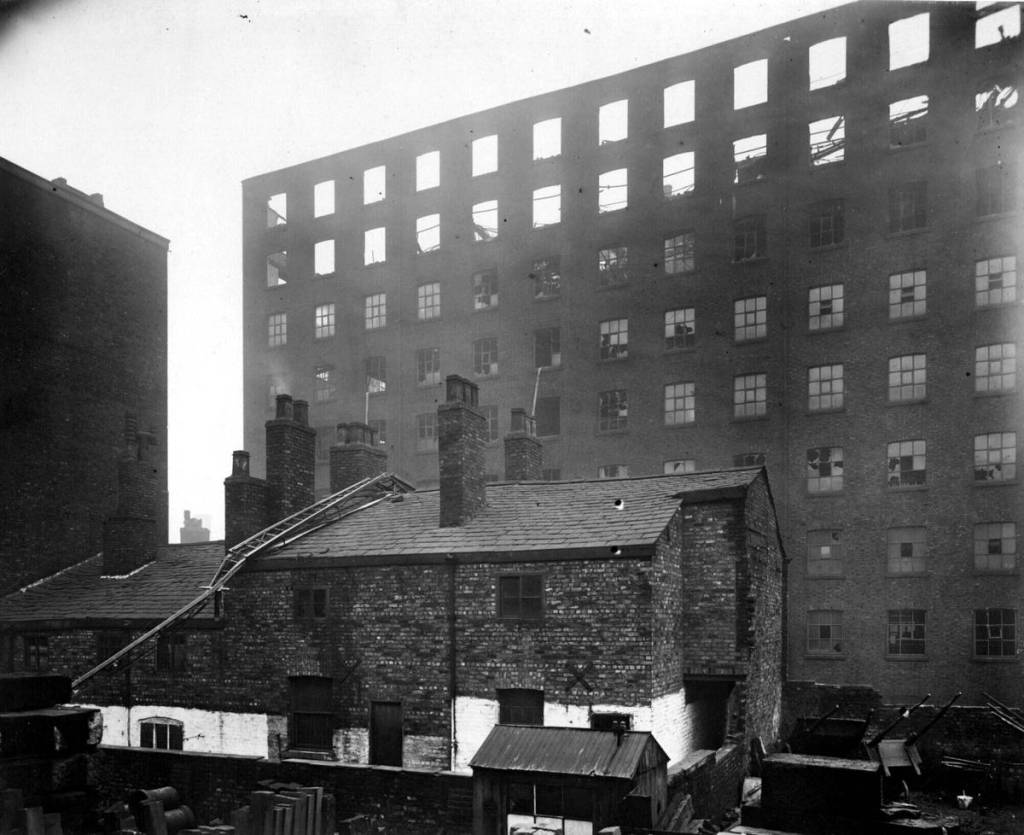
Within a decade, as the complex expanded to include Decker Mill and New Mill, the site housed over 84,000 spindles and employed more than 1,300 workers, making Murrays’ Mills one of the largest manufacturing operations on the planet and earning Manchester its legendary moniker, Cottonopolis.
The genius of the complex lay not just in its vertical power, but in its logistical design. When the adjacent Rochdale Canal opened in 1804, the Murrays engineered a private subterranean tunnel off the canal that delivered barges straight into a central internal canal basin enclosed by the quadrangle of mill buildings. Raw cotton from America and coal from Lancashire coalfields glided right into the heart of the factory, while fine-spun yarn moved effortlessly out to market.

As Britain’s industrial age waned through the mid-20th century, the soot-stained giant fell into a long, quiet slumber. By the late 1990s, after decades of abandonment, Murrays’ Mills stood derelict, its roof collapsed, floors rot-infested, and trees sprouting through broken brickwork. However, its unmatched architectural heritage earned it a Grade II* listed designation, protecting the world’s oldest urban steam mill from the wrecking ball.
Modern day Murrays’ Mills

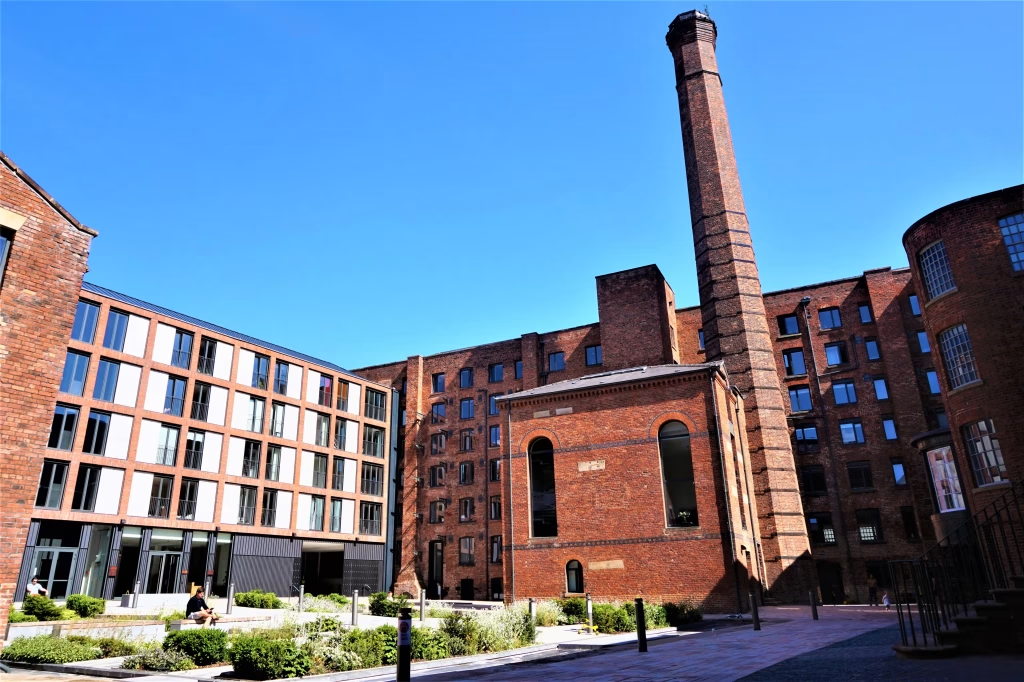
A £33 million restoration led by Manchester Life brought the landmark back from the brink of decay. Craftsmen meticulously repaired millions of original red bricks, restored the historic cast-iron columns, timber beams, and engine houses, and cleared the forgotten central basin.
Today, the towering eight-storey landmark has been reborn as 124 luxury homes, where modern apartments wrap around the restored canal basin and a tranquil landscaped courtyard—a peaceful oasis built inside the very birthplace of modern industry.
The structure no longer towers above its surroundings, with factory and mill buildings characterising the entirety of the Ancoats area, alongside cutting-edge skyscrapers climbing the skyline, but it remains a feat of architecture and engineering that stands out from the rest.