
A long-discussed plan to carve a road tunnel beneath the Peak District is back on the table, with a new proposal claiming it could finally make the long-debated Manchester–Sheffield link a reality and at a fraction of the previously estimated cost.
A proposed tunnel linking Manchester and Sheffield through the Peak District could cut journey times by up to 30 minutes
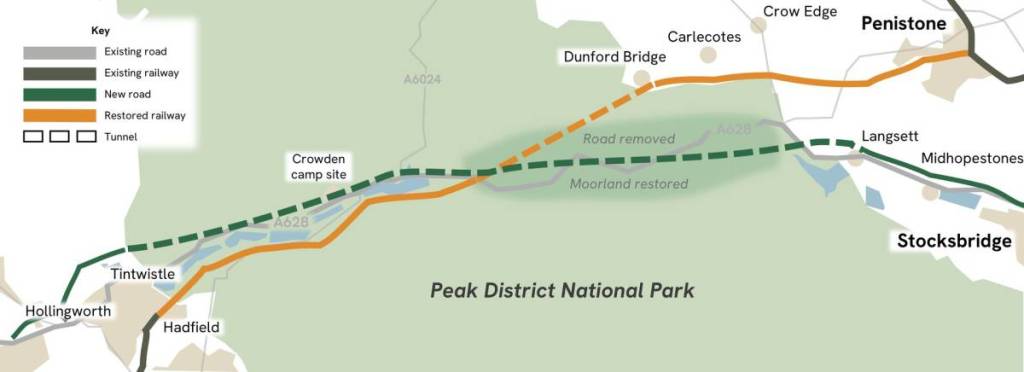
The idea of a direct underground route between Manchester and Sheffield has resurfaced in the form of “Trans-Pennine Connect”, an ambitious scheme proposing a 14-mile dual carriageway tunnel beneath the Peak District.
Backers say the project could slash journey times by up to 30 minutes, ease chronic congestion across existing routes, and unlock significant economic growth across the North.
Why is the Trans-Pennine Connect needed?
For decades, the Pennines have remained a stubborn bottleneck between two of England’s largest city regions.
Motorists navigating the A628 Woodhead Pass or Snake Pass are all too familiar with slow-moving traffic, unpredictable weather conditions and lengthy diversions.
Around 20,000 vehicles a day currently cross the Peak District, including a high volume of freight traffic, a figure that underlines both the demand and the strain placed on the national park’s roads.
What makes this plan different from previous ones?

The new proposal aims to take that pressure off the surface entirely.
By moving traffic underground, campaigners argue the scheme could not only improve connectivity but also allow large swathes of the Peak District to be restored to a more natural state, free from heavy traffic.
At the heart of the renewed optimism is cost.
Previous government-backed proposals for a similar tunnel were shelved after estimates soared to £10.6 billion, largely due to the use of conventional tunnel-boring machines.
However, infrastructure group Future Works – the team behind Trans-Pennine Connect believes it can deliver the scheme for under £2 billion.
How could the Trans-Pennine Connect be built so cheaply?

Their solution draws heavily on Scandinavian engineering, particularly Norway’s approach to tunnelling.
Instead of relying on expensive machinery, the plan would use a “drill and blast” method, a technique that combines controlled explosions with smaller specialist teams and leverages the natural strength of surrounding rock.
Proponents say the geology of the Pennines is well-suited to this approach, mirroring conditions found in Norway, home to some of the world’s longest and most cost-effective road tunnels.
Future Works co-founder Michael Dnes, a former Department for Transport insider, has said the scheme is partly driven by frustration that earlier plans never materialised.
Now working outside government, he and his team are attempting to reshape the conversation, not just around engineering, but funding too.
How would the Trans-Pennine Connect be funded?
Rather than relying on direct public investment, the group suggests the tunnel could be financed through a mix of private capital, local authority backing and tolling.
Similar models are widely used in Scandinavia, where infrastructure is often funded upfront and paid back over time by users. Backers also point to the potential involvement of northern pension funds, which collectively hold vast investment capital.
Alongside the road tunnel, the scheme also revives another long-lost piece of northern infrastructure: the Woodhead railway line.
Closed to passengers in the 1970s and fully shut in 1981, the route once provided a fast rail link between Manchester and Sheffield. The new plan suggests reinstating it alongside the tunnel, potentially creating a dual road-and-rail corridor that could transform east-west connectivity.
There are, however, significant hurdles ahead. The proposal currently has no formal backing from central government, which has previously ruled out a trans-Pennine tunnel on both financial and environmental grounds.
A Department for Transport spokesperson reiterated that position, pointing instead to ongoing improvements along existing routes such as the A628 and A616.
Regional authorities have struck a more cautious but open tone. The East Midlands Combined County Authority acknowledged the long-standing challenges of poor cross-Pennine links and welcomed fresh thinking around funding and deliver.
Though it emphasised that any proposal would need to prove its affordability, environmental impact and wider strategic value.
What happens to the Peak District?
Those environmental considerations are likely to be a central battleground. While supporters argue that tunnelling traffic could help “rewild” parts of the Peak District, critics may question the impact of large-scale construction beneath a protected national park, as well as the broader implications of encouraging road use in an era of net zero targets.
When could the Trans-Pennine Connect happen?
Future Works believes it can move faster than traditional infrastructure timelines, with ambitions to begin construction before the end of the decade and open the route by the mid-2030s.
Whether that proves realistic will depend on funding, planning approval and political backing — all of which remain uncertain.
For now, Trans-Pennine Connect is back in the conversation, offering a bold vision for how to finally bridge one of the North’s most stubborn geographic divides.